This blog is also about the burial of perception in Western thought, the unwillingness or inability of philosophers to use their senses to investigate the structure of the incredible scenes that surround us.
What’s my evidence for saying that heavy thinkers consistently ignore what is right in front of them?

I can only point to signs of its burial, since aside from Plato and Descartes, I don’t know of any deliberate efforts on the part of philosophers to kill perception.
However, the trouble they have had with realism indicates that how we connect with the trees, ponds and garbage cans in our midst has been a problem for philosophers, and it could be because in their effort to elevate theory over observation, they felt it necessary to one-up common sense.
For example, those who followed Descartes after his experiment with the stove became skeptical about sense perception. They embraced representationalism — the idea that we need an intermediary to bridge the gap between us and the world. As a result, and for a long time, academic talk about perception was replete with entities like sense data, sense impressions, interfaces. We could not perceive the world directly because we could never know how much sense data were interfering with and distorting our point of view.
The correspondence theory of truth is another area where philosophers did everything they could to avoid acknowledging that our senses tell us things that are true about physical reality. This theory states that propositions are only true if they correspond to reality. But since it fails to provide any entities to which statements could correspond, this makes no sense. There is no there, there.

If they just admitted that perception is how propositions hook on to reality there would be no problem.
Another sign that perception has been downplayed or quashed is the strong dualistic bent in Western thinking. Dualism, reductionism, the separation of entity and behavior, are all signs that something other than direct contact with the rocks, trees and roads we live within and around, is determining our thought processes. As ecofeminists are fond of repeating, nature is not divided up into mind/body, spirit/matter, male/female, culture/nature etc. Nature doesn’t have hierarchies. Everything is interconnected in nature, which has a seemingly infinite capacity for beauty and regeneration. A more realistic approach to reality would explain self and society using metaphors based on nature.
So why don’t deep thinkers see this? Why do they reduce and dichotomize everything?

Feminists argue that the analytic mind-set that took hold after the Enlightenment with its emphasis on progress and technology prevents the adoption of a more earth-friendly (female) outlook, and that the division of everything into two parts is just a repetition of the larger separation between man and nature and the domination of one group over another, particularly men over women and first world over third world peoples.

I think the problem goes deeper than this. I agree that thinking the world is black and white neglects to observe how intertwined and interdependent entities and processes are. But thinking that everything is connected can be a trap too, especially if it leads you to ignore the integrity and intricacy of individual parts.
Finally, there is the extreme aridity of most philosophical writing. Forgive me for being blunt, but with the odd exception of Alfonso Lingis and David Abram and maybe one or two others, most philosophy is as dry as Melba toast. The writing is on such an abstract level you can barely breathe without oxygen support. References to concrete things or places are like blueberries in a poor man’s pancake. It seems that if philosophers were to write about the actual suitcases or fruit stands or bus stops that surround them, they’d be accused of an unforgivable softness no man would willingly admit to anyone but his doctor. To believe that when you look at the scenes around you, you perceive the world itself is disparaged as a form of philosophical infancy. It’s gauche. Undergraduate. Naive. You haven’t thought hard enough yet. To get from A to B you don’t use your senses. You use your neurons.
To be sure, there are plenty of reasons to doubt perception as a pathway to truth. It is easily manipulated and there are many situations where it cannot be trusted. It is also not well understood. Nobody knows how it works. How do the visible and audible aspects of the scenes around us get transferred to our brains? Finally, there is a strong intellectual bias in Western culture that makes anything involving the body deeply suspect.
But, these are just quibbles. Using your eyes and ears to make sense of what you perceive is essential for survival. You wouldn’t question perception if a car suddenly crashed into your home.

Or if you were outside coatless in minus 30 degree weather.

So why isn’t it more essential for Western thought?
I think the real problem with perception for us, is that Western culture is very linguistic and perception is how language hooks on to biological reality. That means it is both a partner and a challenge to the representational system we use to think with. And systems don’t like challenges.
When we want to be realistic we make close observation of the subject we want to talk about inform what we say. We visit hospitals, schools, take notes and photographs, write down what we see and hear.

But if we do not care whether what we say is true or not, close perception (ours or someone else’s) gets in the way of what we are doing and can act as a brake on our plans. Therefore, unless we are trying to tell the truth, we are in constant warfare with it.

Mikhail Rakityanskiy
Could it be, then, that perception is as buried as it is because there have already been so many lies? Something like that. Language’s ties to biological reality are arbitrary which means words can be about anything, real or not real, true or not true, possible or not even possible. On the other hand, perception lets us know that there are limits on what we can do because it informs us about the real features of our lives, each other and the physical world.
Wanting to be free of limits is not peculiar to the West. It’s a feature of every culture that uses language. But the destructive powers of language have been harnessed most completely in the West.

If perception stops you from saying what you want to say (and doing what you want to do) why put up with it?
Use it just enough to buy groceries, but then forget about it.
What About Phenomenology?
What about phenomenology? What about it? Its founder, Edmund Husserl was no friend of the so-called external world. In fact, he bracketed it off, limiting discussion to that which appears to consciousness in the form of impressions, glimpses, suspicions. He was an idealist whose curiosity stopped at the edge of the so-called “intentional object,” that is, the object as it is present to a conscious observer. Although phenomenology called for a return to things themselves, paradoxically it considers them only insofar as they appear to the human brain.
Merleau-Ponty was a bit better (he inspired David Abram), but he too didn’t seem to be able to get out of his own head.
Now we have Object-Oriented Ontology, a promising label if there ever was one. The Kantian human-world gap – the idea that reality revolves around the conditions of our knowing it – is scorned. Objects are granted an independent existence outside intentionality that is knowable. Husserl’s distinction between an object and its qualities becomes the opening through which a huge effort is made to plumb the depths of things-in-themselves. Heidegger’s tool-analysis is the rubric for a new metaphysics that finds in objects a fourfold structure of Real objects and Real Qualities (which are withdrawn) and Sensual Objects and Sensual Qualities (which are apparent in the world) The central mission of philosophy is “to theorize the deformations and breakdowns in the bond between an object and its qualities.”
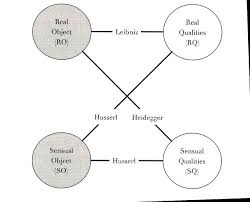
It sounds very convincing. There is no human point of view to distort things. Metaphysics is re-instated. Objects are made the primary substance. Everything is an object, so what holds true of neutrons also holds true of governments. The whole cosmos can be mapped as a version of four tensions, three radiations and three junctions.
But where is perception in all of this? Where is the exterior of objects, the part that we see and touch? Where is the world that stares back at us inscrutably from all corners of the room?
By getting rid of the human-world gap we also got rid of the system that lets us pick up on an object’s physical presence, its beauty, its meaning and value, its life on the surface of the planet.

Was this deliberate? I think so.
To have a metaphysics of objects, it’s necessary to separate out the essence of objects from countless empirical details whose flash and odour get in the way of achieving piercing analysis. An ontology that includes the way objects look or behave in real settings like your grandfather’s tent or the mountains in Banff National Park would not be a real ontology. It would not be a true metaphysics. Even though the physical side of objects and their particular location is what concerns most of us in daily life, this is not what interests object-oriented ontologists. They are interested in developing a new theory of overarching basic structures.

So if the nature of being does not include what we perceive with our senses because that would put objects back into human consciousness, and object oriented ontologists want to grasp reality in its own right, not just as it appears to humans (correlationism), object oriented ontology may be the final triumph of western thought over the external world. The nail in the coffin. The death of perceptual reality. It’s a strange world that cannot be perceived, that can only be conceived. Graham Harman compares reality to a deck of cards. Particularly when the world we do perceive is so strange and beautiful, it’s troubling that even object-oriented philosophers don’t want to take it on. The most perceptive thing they can say about reality is that it is weird. No kidding.
What about the argument that it’s not philosophy’s job to celebrate or raise questions about the “external” world? That philosophy’s job is to take nothing for granted, subject all claims to critical scrutiny, and inch by inch show the warranty for different claims ?
There’s definitely truth in that. The history of philosophy is not exactly larded with realists, and we need a discipline that shows us how to think clearly.
Then who does want to systematically study the incredibly beautiful scenes that surround us and the way that objects fit into what can only be described as some sort of set-up or theater? Novelists? Physicists?
Owing to the extreme reductionism of physics, I’d go with the novelists, especially Iris Murdoch, whose descriptions of French villages, London, the English countryside were quite detailed and shrewd. But despite the fact that she was also a philosopher, I wouldn’t call her representation of the world she lived in systematic.
As you can tell, I want philosophy to be more realistic.
Hilary Putnam is helpful here. He started out thinking that successful theories and explanations captured something fundamentally true about the world by corresponding with it. But then he realized that explanations don’t correspond with the world in just one way. So he threw out the correspondence idea of truth to settle for something more modest, like “ideal coherence of our beliefs with each other.” He accepted conceptual relativity. All we had to go on about the world was sense data and sense data could be interpreted in different ways.
However, he began to wonder about sense data too. Who said there was an interface between us and the things we see around us? It sounds reasonable because it provides an explanation for how aspects of the world get transferred to our brains. But is there any evidence that sense data exist? Why does perception have to be indirect? Maybe our visual and hearing equipment is capable of going all the way to the objects themselves, without help? In fact, maybe we perceive the world directly after all, just as non-educated people have thought for centuries, and the only stumbling block is that we have different conceptual systems to interpret what we perceive?
Putnam’s willingness to go back and rethink what he once thought is delightfully cleansing. He was determined to try to bridge the gap between what we perceive and what we say about it. While I know there are some who disagree with his new-found respect for the realism of the common man, there is something very appealing about a philosopher who wants his work to reflect what ordinary people see and hear. It means that philosophy is not as elitist as it sometimes seems. It also means that careful thinkers are tackling questions that mean something to you and me. I, for one, did not study philosophy in college but find myself reading it now and then because it is the only field that comes close to tackling the questions I am interested in. Back in 1994, for example, I was deeply pleased to read Putnam’s defense of direct perception in the Journal of Philosophy because I’d been struggling to explain something I perceive to people who claimed that direct perception was impossible He also put me onto William James whose radical empiricism taught me so much about the relationship between language and perception.
But if other philosophers think their connection to the world is dicey, and they have a bad habit of splitting things in two, and they prefer theorizing about structure to using their perceptual powers to examine the physical world with care, how are they ever going to help us figure out what is going on?
They won’t, of course. Not unless they get off their idealist path and embrace common sense realism will philosophers tackle the complexity of our actual situation as inhabitants of the Blue Planet. Even then, it’s not likely they’ll stay realist for long unless they also get control over language, because language is the real source of our difficulties, both with dualism and the truth. Language interferes with perception. It causes us to lose touch with what exists. Not always. But enough to be dangerous.
What are the chances of that happening? I don’t know. I’m not a philosopher. I’m just a woman with a lot of questions. But I know that I didn’t start to question language’s advisability as a representational system until I looked at what is right in front of me carefully, and was silenced by its beauty and power. Maybe we’ll have to wait until philosophers undergo a similar experience.
 the universe on earth